
Using Storytelling to Strengthen Continuous Improvement
I’m a movie geek. When anyone asks me to name my favorite film genre, I always give the same answer: I enjoy just about any kind of movie if I find the story and the characters compelling.
I love all the aspects of filmmaking that are not only technically impressive, but also move the narrative forward or give the humans in the story depth or complexity. For example, I can talk at length about how superior fight choreography in an action movie (like good dance choreography in a musical) should tell the audience something about who the characters are as people.
About a year ago, while trying to think of a good hook for a Lean conference proposal, I was inspired to let my love for movies collide (in a good way) with my passion for improvement. I decided to try mapping the A3 to the “Pixar Pitch” storytelling framework. This framework, credited to Emma Coats, a master storyteller at Pixar Animation Studios, is the story "spine" of just about every one of their movies, including "Toy Story" and "Finding Nemo."

Ever since then, I’ve been sharing the hero's journey of movies like "Up" and WALL-E" to encourage teams to connect their data to human impact and highlight the compelling narrative embedded in their improvement stories. Just as moviemakers use compelling storytelling to emotionally engage viewers, improvers can encourage buy-in and understanding by highlighting how their efforts make life better for customers, patients, workers, or other key partners.

During my recent AME Back to Basics Summit workshop, I shared the Pixar Pitch and, over the last few weeks, I’ve been experiencing one of the most rewarding parts of my work. People have let me know how they’re taking my idea and making it their own.
For example, a few days after the Summit, I got an email from Keith A. Inglis of Pharmavite. He shared an image (shared with permission) created by his colleague, Suraj Rajashekhar, depicting their adaptation of the framework. I love how they applied it in their context, complete with engaging visuals and pro tips.
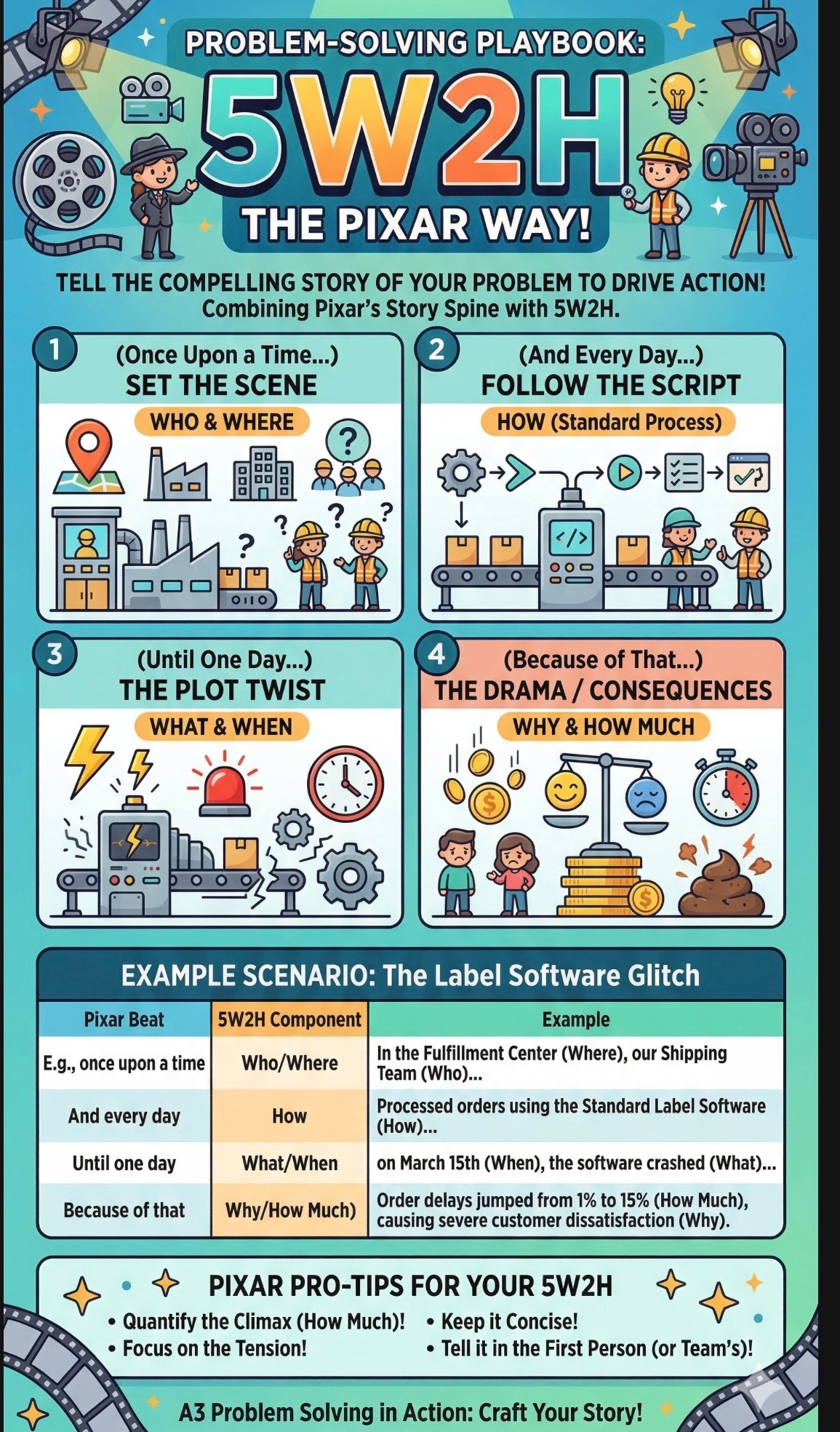
According to Keith, “We’re finding that just applying this one element of problem solving is helping teams get much clearer on the problem they’re actually trying to solve—and, as a result, more focused on potential solutions.”
When you put something out in the world, you hope for exactly this kind of thing. It’s exciting to see such a thoughtful adaptation put to practical use. I can hardly wait to see how their use of narrative evolves.
Image by Erik Mclean via Unsplash

